
Getting started
How long does it take to learn Saudi Arabic?
About three months to get by, six to twelve to hold real conversations, a couple of years to feel fluent — if you live in Saudi and use it daily.
16 September 2026 - 13 min read
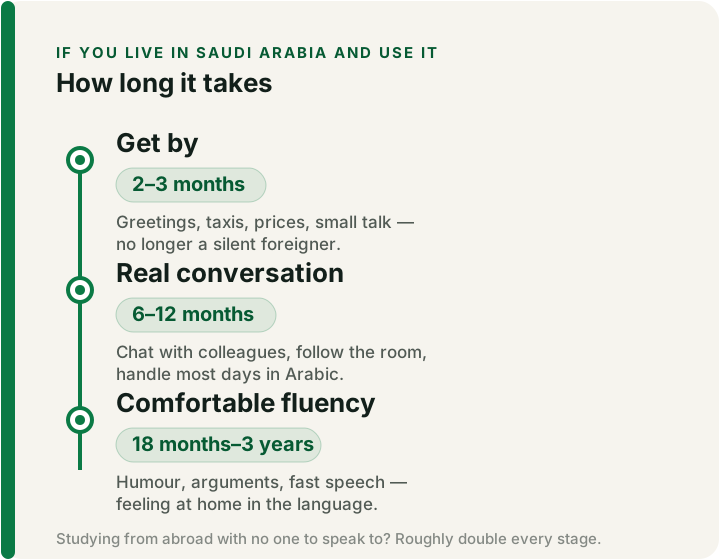
For an English speaker starting from nothing, about three months to get by, six to twelve months to hold a real conversation, and eighteen months to three years for comfortable fluency — if you live in Saudi Arabia, study a few hours a week and actually use what you learn. Studying from abroad, with nobody to speak to, roughly double every one of those numbers.
That is the honest answer. The rest of this page is the working: what "learn" means at each level and roughly how many hours it costs, why the first weeks are the steepest, why living here is the single biggest multiplier, why dialect gets you talking sooner than formal Arabic, and what speeds the whole thing up or quietly stalls it.
First, what does "learn" mean?
Nobody asks how long it takes to learn Arabic and means the same thing. Three goals cover almost everyone who writes to us:
- Get by. Greetings, numbers, prices, directions, the taxi, the supermarket, the pharmacy, the security guard at your compound. You can open and close a simple exchange without switching to English.
- Hold a real conversation. You can chat with a colleague about their weekend, follow most of what is said around you at a majlis or in a meeting, ask for what you need and understand the answer even when it isn't the one you rehearsed.
- Comfortable fluency. You stop translating in your head. You can joke, argue, tell a story, follow fast speech between two Saudis, and shift register when the situation calls for it. You still make mistakes; they no longer stop the conversation.
Each of these is a different amount of work. Here is the honest version.
The estimate table
These are estimates for an English speaker with no prior Arabic, learning the spoken Saudi dialect first, studying consistently. They are not promises, and they assume the study is real (speaking, listening, active recall), not passive scrolling. "Hours" counts focused study plus real use, which is why living in Saudi changes the elapsed time so much: an evening with Saudi colleagues is an hour you didn't have to schedule.
| Goal | Rough total hours | Living in Saudi, using it (about 5 hrs/week study) | Studying from abroad (about 5 hrs/week, little use) | What it gets you |
|---|---|---|---|---|
| Get by | 60–100 | 2–3 months | 4–6 months | Greetings, shopping, taxis, directions, small talk; you are no longer a silent foreigner |
| Real conversation | 300–500 | 6–12 months | 18 months–2 years | Chat with colleagues and neighbours, follow the room, handle most everyday situations in Arabic |
| Comfortable fluency | 1,000+ | 18 months–3 years | Several years, and rarely without a long stay | Humour, arguments, fast speech, feeling at home in the language |
Two things to notice. The gap between the two "living" columns grows with every level: you can get by on study alone, but you cannot get fluent without a great deal of real use. And the jump from getting by to real conversation is the biggest single jump on the table — roughly four to five times the work — because it is where you stop using memorised phrases and start generating your own sentences.
For context: the organisations that train diplomats put Arabic in their hardest group for English speakers, alongside languages like Mandarin and Japanese, with professional-level proficiency running into the thousands of classroom hours. That figure is for formal Arabic to a high standard. Spoken Saudi to a conversational standard is a much smaller job, and that is precisely why we teach it first.
Why the first weeks are the steepest
Every English speaker hits the same wall in the first month, and it is worth knowing it is coming so you don't mistake it for a lack of talent.
The sounds. Arabic has several consonants English simply doesn't have. The ones people struggle with are:
| Letter | Sound | The problem for English speakers |
|---|---|---|
| ع | ʿayn | A voiced squeeze deep in the throat; there is no English equivalent at all |
| ح | ḥ | A breathy, whispered h from the throat — like fogging a mirror |
| خ | kh | The sound in Scottish loch, which most English speakers have heard but never had to produce |
| غ | gh | A gargled r, close to a French r |
| ق | q | A k from the back of the throat — though in Riyadh you will mostly hear it as a hard g |
| ص ض ط ظ | ṣ ḍ ṭ ẓ | "Heavy" versions of s, d, t, th; the tongue is pulled back and the vowel around them darkens |
None of these is impossible. All of them take a few weeks of deliberate practice before your mouth stops resisting. Until then, words you know perfectly well will come out wrong, and that is normal.
Almost no shared vocabulary. If you learn Spanish, half the words are cousins of English ones. Arabic gives you very little for free. Nearly every word is new, which is why the early weeks feel slow: you are building the vocabulary floor from nothing.
The root system. This one turns from obstacle to advantage quickly. Most Arabic words grow from a three-consonant root. Take ك-ت-ب (k-t-b, "writing"): كتاب kitaab is "book", مكتب maktab is "office" (literally "place of writing"), كاتب kaatib is "writer". Once you have a couple of hundred roots and a feel for the patterns, new words stop being random and start being guessable. That is the point at which vocabulary suddenly accelerates, usually somewhere in month two or three.
The alphabet. Twenty-eight letters, written right to left, most of which change shape depending on where they sit in a word. It is more manageable than it looks, and it is also optional at the start — more on that below.
The biggest multiplier: living in Saudi Arabia and using it
If you take one thing from this page, take this. The single largest variable in how long it takes is not talent, not age, not the app you choose. It is whether you are surrounded by the language and whether you use it.
Someone in Riyadh who says كيف حالك؟ kaif haalak ("how [is] your condition?" — how are you) to the security guard every morning, orders coffee in Arabic, asks the price with بكم هذا؟ bikam haadha ("for how much [is] this?") and sits through a weekly dinner with Saudi in-laws will reach the conversation stage in months. Not because they study more, but because every day hands them twenty tiny rehearsals, each with instant feedback, and their brain files the language under "things I need" rather than "things I am studying".
Someone doing an hour a week in a flat in London is getting none of that. They can absolutely learn — plenty do — but the elapsed time doubles or worse, because each lesson is followed by six days of silence.
This is the honest reason Speak Saudi exists as an academy for people living in the Kingdom. The classes are the structured part; the country is the practice ground, and the two together are what compresses the timeline. Our classes are built to send you out of every hour with something you can use before the next one.
The uncomfortable corollary: living in Saudi Arabia does nothing on its own. Riyadh and Jeddah run in English if you let them. Plenty of expats leave after five years with twenty words. Being here is the opportunity, not the result.
Dialect first gets you talking in weeks, not months
There is a version of "learning Arabic" that takes far longer than it should, and it starts with choosing formal Arabic — Fusha, or Modern Standard Arabic — because it sounds more serious.
Fusha is the language of news, books, sermons and official documents. Nobody in Saudi Arabia speaks it at the coffee shop. If you start there, you spend months on grammar and vocabulary you cannot use in a single conversation, and when you finally try, the replies come back in dialect and you understand almost nothing. We have written the full comparison at MSA vs Saudi dialect, and the broader question of which Arabic to learn if you live here.
The spoken dialect works the other way round. In the first two weeks you can learn:
- وش أخبارك؟ wish akhbaarak — "what [are] your news?" — how are things?
- أبغى قهوة abgha gahwa — "I want coffee"
- وين المطعم؟ wain al-mat'am — "where [is] the restaurant?"
- ما فيه مشكلة maa fii mushkila — "there is no problem"
- شوي شوي shwayy shwayy — "little little" — slowly, bit by bit
and go and use them the same afternoon. That loop — learn it, use it, hear it back, adjust — is what makes dialect faster to the thing most people actually want, which is to talk to the people around them.
One small note: "Saudi dialect" is really a family. The main split is between Najdi (Riyadh and the centre) and Hejazi (Jeddah, Makkah, Madinah), and the differences are real but not large; we cover them in Najdi and Hejazi differences. They do not change the timeline. Learn the one for the city you live in and the other will come easily later.
Do you need to learn the script?
Not to start speaking, no. Reading Arabic is a separate skill from speaking it, and you can add it whenever you like.
Plenty of people learn their first few hundred words entirely by ear, using transliteration as a crutch, and are having real exchanges before they can read a shop sign. That is a legitimate route, and it is the fastest one to conversation.
That said, the alphabet is a smaller job than it looks: with a bit of practice most people can sound out words slowly within two or three weeks, and it pays back fast. Once you can read, you stop depending on somebody else's transliteration, your pronunciation of the throat letters improves because you can see them, and menus, signs and messages from Saudi friends open up. Our advice is to start speaking on day one and add the script in the first month or two, in parallel, without letting it gate anything.
What speeds it up
- Daily contact, even five minutes. Twenty minutes a day beats two hours on Saturday. Frequency matters more than duration, because the brain needs the language to keep showing up.
- A teacher or a conversation partner from the start. The most common regret we hear from people who spent a year on apps is that they could recognise a lot and say very little. Speaking is a physical skill; you need someone to speak to and someone to tell you what came out.
- The highest-frequency words first. A few hundred words cover the great majority of everyday speech. Learn those before anything clever. Our Saudi phrasebook is built around exactly that set, and Essential Saudi Dialect takes the same words and shows you how they fit together.
- Not chasing perfection. Say it wrong, get corrected, say it again. The learner who speaks badly every day overtakes the learner who waits until they are ready, every single time.
- Using the country. Sit in the majlis. Ask the barber. Talk to the driver. Say الحمد لله al-hamdu lillah ("praise [be] to God") when someone asks how you are and watch the conversation open.
What slows it down
- English everywhere. In Riyadh and Jeddah you can go years without needing a word of Arabic, and if you never need it, you will never learn it. You have to choose to use it when English would be easier.
- Perfectionism. Waiting until the sentence is right before you say it means you say almost nothing. Saudis are, in our experience, endlessly patient with a foreigner trying, and almost never correct you unkindly.
- Studying Fusha when you wanted to talk. See above. A year of formal Arabic gets you to the point where you can read a newspaper headline and still cannot ask a colleague about their weekend.
- No speaking practice. Flashcards, videos and grammar notes all have their place, but none of them exercise the muscle you actually want. If a week goes by without you producing sentences out loud to another human, that week barely counts.
- Stop-start studying. Two months on, three months off, restart from the beginning. Arabic punishes gaps more than most languages because so little of it sticks by resemblance to English. Slow and constant beats fast and occasional.
If you want the full map of every route in — classes, self-study, free resources, and how to combine them — it is at learn Saudi Arabic.
Questions people ask
Can I learn Saudi Arabic in 3 months? You can get by in three months — comfortably, if you live here and use it daily. Greetings, numbers, prices, directions, simple questions and a stock of polite phrases are all realistic. You will not be holding open-ended conversations at three months, and anyone who promises you will is selling something. Three months of real effort is enough to stop being a silent foreigner, and that alone changes how people treat you.
Is Saudi Arabic harder than other dialects? Not meaningfully. All Arabic dialects share the sounds, the root system and the same basic grammar, so the difficulty for an English speaker is much the same wherever you start. Saudi dialect has one honest advantage for learners: a lot of its everyday vocabulary sits close to formal Arabic, so what you learn transfers well. It also has one practical advantage that outweighs everything else: if you live in Saudi Arabia, it is the one you will hear all day.
How long does it take just to get by? Roughly 60–100 hours of real study and use. Living in Saudi and studying a few hours a week, that is two to three months. The first two weeks are the hardest; once your mouth can make the sounds and you have a hundred words, it gets noticeably easier.
Do I need to learn to read Arabic? Not to start speaking. Reading is a separate skill you can add at any point, and many people are having real exchanges before they can read. We recommend adding the script within the first month or two — it takes a couple of weeks of practice to sound words out — because it improves your pronunciation and stops you depending on transliteration. But do not let it hold up the speaking.
How long if I already speak Egyptian or another dialect? Weeks, not months, to adjust. The sound system, the roots and the grammar carry straight over; what changes is a layer of everyday vocabulary, a handful of pronunciation habits (the ق as a hard g in Riyadh, for example) and the rhythm. Someone with solid Egyptian or Levantine Arabic usually follows Saudi conversation within a few weeks of exposure and sounds local, or close to it, within a few months. The same applies, in a different way, if you already read Fusha: you have the foundation and need the spoken layer on top.
I live in Riyadh — how fast can I actually pick it up? Faster than anyone studying from abroad, provided you use it. With a class or two a week and a habit of speaking Arabic first — to the driver, in the shop, with colleagues — three months gets you by and six to twelve months gets you into real conversation. The honest warning is that Riyadh will let you avoid it completely if you prefer. The people who pick it up fastest are the ones who decide, early, to be a little uncomfortable every day.
Find your level
Everything above assumes you are starting from zero. Most people who have lived here a while are not: they have pieces, and they don't know how the pieces add up.
The free level test tells you where you actually are, in two minutes. Then book a free trial hour and we will tell you, honestly, how far you are from the goal you have in mind and what the fastest route to it looks like.